
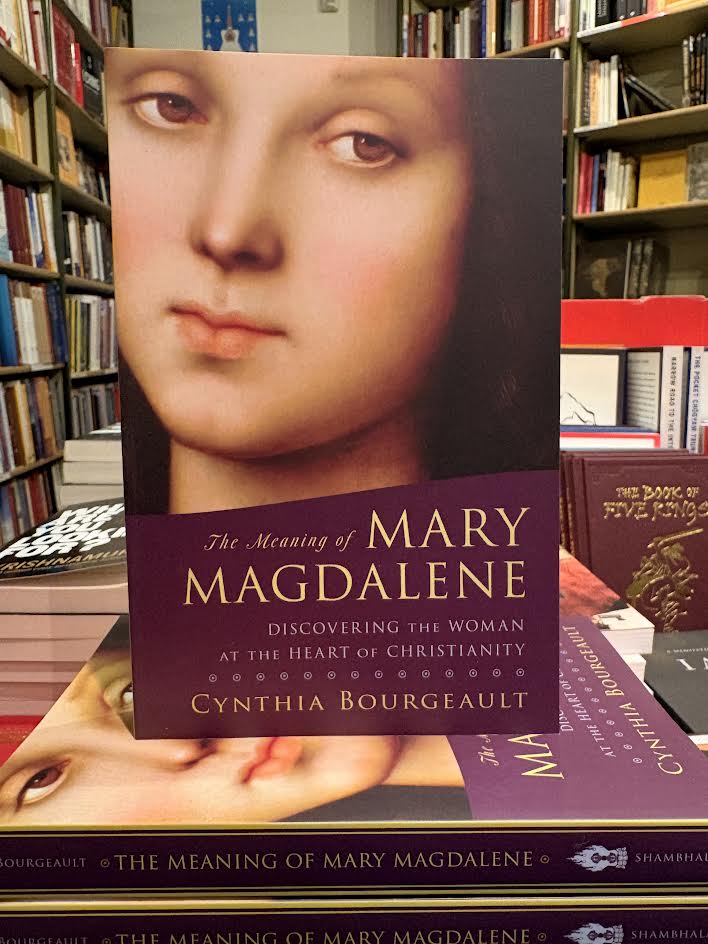
The Meaning of Mary Magdalene by Cynthia Bourgeault
Description
The Meaning of Mary Magdalene, Discovering the Woman at the Heart of Christianity by Cynthia Bourgeault
Mary Magdalene is one of the most influential symbols in the history of Christianity-yet, if you look in the Bible, you'll find only a handful of verses that speak of her. How did she become such a compelling saint in the face of such paltry evidence?
In her effort to answer that question, Cynthia Bourgeault examines the Bible, church tradition, art, legend, and newly discovered texts to see what's there. She then applies her own reasoning and intuition, informed by the wisdom of the ages-old Christian contemplative tradition. What emerges is a radical view of Mary Magdalene as Jesus's most important disciple, the one he considered to understand his teaching best. That teaching was characterized by a nondualistic approach to the world and by a deep understanding of the value of the feminine. Cynthia shows how an understanding of Mary Magdalene can revitalize contemporary Christianity, how Christians and others can, through her, find their way to Jesus's original teachings and apply them to their modern lives.
Publisher: Shambhala
If you like this, you might also like:


The Rape of Man And Nature by Philip Sherrard
out of stock - £20.99
The Rape of Man & Nature, An Inquiry Into The Origins & Consequences Of Modern Science, by Philip Sherrard
The growing threat of ecological disaster weighs heavily on people’s minds. In this book, first published nearly thirty years ago but still acutely relevant, Philip Sherrard traces the crisis back to what he believes is its true origin: the incremental replacement of a participatory and sacramental understanding of creation with the more detached scientific mentality that predominates today. Sherrard believes that by accepting this materialistic, mechanistic worldview we are contributing to our own dehumanization — with drastic consequences for the natural world.
Most people take for granted the assertion that modern science rests on pure, objective fact. For Sherrard such an assertion is, instead, a provocation. Modern science, he argues, emerged from developments in medieval Scholastic thought and is founded on a host of unquestioned philosophical and metaphysical assumptions. Only once we have understood more fully these assumptions and subjected them to close scrutiny may we begin to recover and reinvigorate the fuller vision of human life and the cosmos that the modern scientific perspective has replaced.
In bold, meticulous prose Sherrard makes his diagnosis of humanity’s present course in uncompromising terms. Yet he does not despair of a solution. There is nothing inevitable, he believes, in the unfolding tragedies of environmental despoliation, unbridled commodification and dehumanization, and cultural decay. Instead, Sherrard calls for a restoration of a sacred cosmology in which the spiritual regeneration of humanity and the ecological regeneration of the earth are seen as deeply enmeshed, in fact, as one and the same.


Human Image: World Image by Philip Sherrard
£20.99
Human Image: World Image, The Death And Resurrection Of Sacred Cosmology by Philip Sherrard
It is now only too evident that the revolutionary changes in mental outlook that took place in western Christendom some three or four centuries ago, and that produced the modern scientific movement, are the major cause of the ecological crisis in which the world finds itself today. Yet the terrifying consequences of the practical exploitation of modern science are usually attributed not to modern science as such — and still less to the mental picture of the universe which it presupposes — but simply to its misapplication and abuse. We are even told, with a naivety that is as inconsequential as it is typical, that modern science must be good because what is true cannot be evil, and since modern science works, or produces results, it must be true.
This book attacks such misconceptions head-on, and at the deepest level. By setting the modern scientific picture of the universe and man's place in it against the background of pre-Christian and Christian cosmology and anthropology, the author shows unambiguously how our acceptance of this picture has literally enslaved us to a vast collective lie whose ramification in the major spheres of our thought and action cannot but vandalize and desecrate both ourselves and the world we live in. The thesis is presented with clarity, eschewing sensationalism and appealing to the disciplined intelligence and its capacity for coherent discourse. The last and perhaps most challenging chapter formulates a cosmological vision in the personalized terms of the sacred mythology of the Christian tradition.


The Sacred In Life And Art by Philip Sherrard
£20.99
The Sacred In Life And Art by Philip Sherrard
We are becoming increasingly aware that the forms of our life and art — of our modern civilization generally — have over the last few centuries been characterized by the progressive loss of precisely that sense which gives virtually all other civilizations and cultures of the world their undying luster and significance: the sense of the sacred. In fact, the concept of a completely profane world — of a cosmos wholly desacralized — is a fairly recent invention of the western mind, and only now are we beginning to realize the appalling consequences of trying to order and mould our social, personal and creative life in obedience to its dictates. It is not even too much to say that we are also beginning to realize that unless we can re-instate the sense of the sacred at the heart of all our activities there can be no hope of avoiding the cosmic catastrophe for which we are heading.
This book is an attempt to clarify what is demanded if we are to have any chance of achieving this. It examines the nature and significance of the scared itself, why the sense of its presence has been eroded from our consciousness over recent centuries, how we can re-awaken this sense, and what such a re-awakening must mean in terms of our personal and creative life. It complements the author's Rape of Man and Nature and Human Image: World Image (both of which focus on the emergence of the thought-forms whose ascendancy has produced our present state of dereliction and chaos), affirming as it does the ever-present, timeless qualities of beauty, love and miracle through which we can be renewed and transformed, whatever the conditions of the world in which we live.